

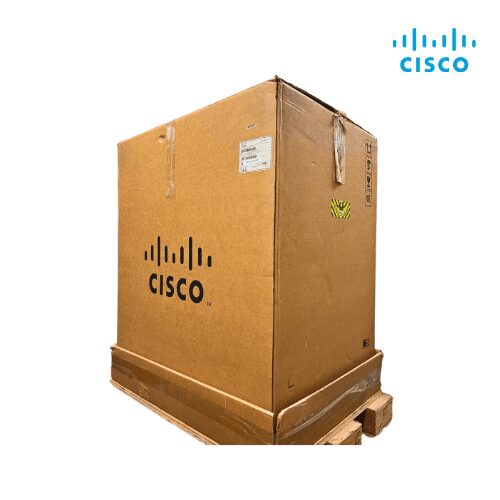






The Cisco uBR10012 Universal Broadband Router is a Cable Modem Termination System (CMTS) designed for high-performance broadband services over cable networks. It plays a crucial role in managing and controlling cable modems, enabling cable service providers to offer high-speed internet and other broadband services to subscribers. The uBR10012 is part of Cisco’s network solutions for cable operators and telecommunications companies, allowing them to provide high-speed internet, voice, and video services to their customers.
The Cisco uBR10012 is qualified for PacketCable 1.0, DOCSIS 2.0, Euro-DOCSIS 1.1, and DOCSIS 3.0 Bronze, designed to meet the current and future needs of cable operators. Based on Cisco IOS Software with full Layer 3 routing capabilities, it offers advanced networking and routing options. Starting from Cisco IOS Software Release 12.3(13)BC, the product supports PacketCable Multimedia (PCMM), enabling cable operators to deploy next-generation multimedia services such as Voice over IP (VoIP), videotelephony, and online gaming. With Cisco IOS Software Release 12.3(13)BC or later, operators can optimize real-time network utilization for prioritized and aggregated resource demands of all PCMM applications, enhancing the broadband subscriber experience by prioritizing or reserving bandwidth for latency-sensitive and feature-rich services. The CMTS fulfills service flow requests and now supports admission control, making real-time decisions on a service request before committing CMTS-controlled resources. Operators can set policies on how resources are allocated among multiple services and establish thresholds to handle demand surges.
The product is also compatible with the CableLabs OpenCable DOCSIS Set-Top Gateway (DSG) specification. DSG allows cable operators to transport upstream and downstream video traffic directly through the CMTS instead of a proprietary, separate video infrastructure. By incorporating out-of-band (OOB) messaging on digitally modulated DOCSIS carriers, cable operators can consolidate cable modem and set-top box (STB) data traffic on a shared DOCSIS channel. Features like admission control and advanced traffic engineering, along with advanced DSG mode on their cable IP networks, help cable operators consolidate voice, video, and data traffic on their cable IP networks. Furthermore, Cisco is a leader in enabling lawful intercept for CMTS. Cisco IOS Software Release 12.3(13)BC introduces support for Service-Independent Intercept (SII) on the Cisco uBR10012. SII support helps operators meet law enforcement needs by providing a standards-based mechanism to intercept IP and voice traffic originating from or destined for subscribers on their network.
The Cisco uBR10012 chassis can be configured with the following components based on your needs:
• Up to eight RF line cards • Up to six Wideband SPAs for Wideband channel bonding • Up to two 4-SPA interface processors (SIPs), which serve as the carrier card for Wideband SPAs • Up to two WAN SPAs for connecting to the IP infrastructure and external networks • Up to two Cisco Performance Routing Engine (PRE) modules • Two Cisco Timing, Communication, and Control cards • Two AC or DC power entry modules (PEMs) or two AC or DC 3300W power supplies
Applications
With the Cisco uBR10012, cable operators can implement advanced IP cable services while supporting a wide range of applications, including:
• High-speed data (HSD) • Managed access and tiered services • Business services • VoIP • Video over IP • VPN
The Cisco uBR10012 offers an optimal solution for expanding services and entering new markets. A combination of services like VoIP, VPN, IP Multicast, and basic HSD is consistently, efficiently, and optimally supported across the network. The Cisco uBR10012 offers an ideal combination of density, reliability, flexibility, and performance.
Wideband channel bonding with modular CMTS architecture:
• Allows efficient delivery of video over IP • Opportunity to expand services and meet the growth of new subscribers • Cost-effective option for scaling DOCSIS deployments
Support for PCMM, PacketCable 1.0 qualification, as well as DOCSIS 2.0 and Euro-DOCSIS 1.1:
• Protects investment and ensures compatibility with next-generation multiservice networks • Provides QoS support, access lists, Multicast, MPLS traffic engineering
Industry-leading density and scalability:
• Reduces capital expenses • Protects existing capital investment
High availability:
• Reduces operational expenses • Increases customer satisfaction • Enables service level agreements • Facilitates latency-sensitive applications such as voice and video
Specifications:
Chassis: 18-rack-unit, with two chassis per 7-foot rack; fully configured chassis weight is 235 lb (106.6 kg); each chassis measures 31.25 inches (79.4 cm) in height, 17.2 inches (43.7 cm) in width, and 22.75 inches (57.8 cm) in depth. Power: DC input voltage from -48 to -60 VDC with a maximum power consumption of 3000W, option for 230VAC with a maximum power consumption of 2400W. Temperature: Operating temperature of 41 to 104°F (5 to 40°C) and non-operating temperature of -40 to 158°F (-40 to 70°C). Interfaces: Eight slots for line cards; four slots for LAN/WAN interfaces; interfaces include Gigabit Ethernet and Broadband SPAs. Compliance and emissions: UL/CSA 60950-1, IEC/EN 60950-1, AS/NZS 60950.1, CAN/CSA 22.2 No. 950-95, EN 300 386.
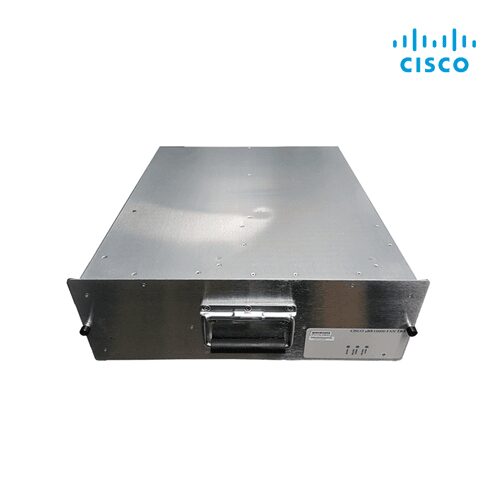
What’s included: uBR10012 chassis + fan tray
The Cisco uBR10012 features these components:
• A maximum of eight RF line cards
• A maximum of six Wideband SPAs for Wideband channel bonding
• A maximum of two 4-SPA interface processors (SIPs), the carrier card for the Wideband SPAs
• A maximum of two WAN SPAs to connect to the IP backbone and external networks
• A maximum of two Cisco performance routing engine (PRE) modules
• Two Cisco Timing, Communication, and Control cards
• Two AC or DC power entry modules (PEMs) or two AC or DC 3300W power supplies
Specification:
Chassis: 18 rack units with two chassis per 7-foot rack; fully configured chassis weight is 235 lb (106.6 kg); each chassis is 31.25 in. (79.4 cm) high, 17.2 in. (43.7 cm) wide, and 22.75 in. (57.8 cm) deep
Power: DC input voltage of -48 to -60 VDC with 3000W maximum power consumption, 230 VAC option with 2400W maximum power consumption
Temperature: 41 to 104°F (5 to 40°C) operating and -40 to 158°F (-40 to 70°C) non-operating
Interfaces: Eight line card slots; four LAN/WAN interface slots; interfaces include Gigabit Ethernet and Wideband SPA
Compliance and emissions: UL/CSA 60950-1, IEC/EN 60950-1, AS/NZS 60950.1, CAN/CSA 22.2 No. 950-95, EN 300 386




Reviews
There are no reviews yet.