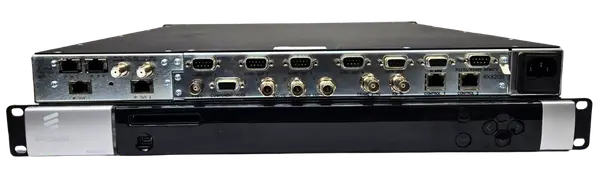
What Is the Ericsson RX8200?
The Ericsson RX8200 Advanced Modular Receiver is a professional-grade integrated receiver-decoder (IRD), designed specifically for television operators, cable headends, IPTV providers, and satellite content distributors.
What sets it apart from any other receiver on the market is its modular architecture: each unit can be configured exactly with the hardware modules and software licenses the operator needs — without paying for functionality it won’t use, and with the ability to expand it in the field as requirements evolve.
Ericsson developed it as their fourth generation receiver, building on decades of expertise in satellite broadcast infrastructure. The result is a platform that combines operational flexibility, broadcast-grade reliability, and compatibility with all the relevant transmission standards in the industry.
Who Is the RX8200 For?
This equipment was designed for professionals operating in demanding environments. Specifically, it is the ideal choice for:
- DTH (Direct-to-Home) Operators: They need to receive and decode satellite signals from multiple transponders with total reliability. The RX8200 supports DVB-S2 in QPSK, 8PSK, and Low Symbol Rate, covering virtually any transponder configuration active on the major Ku and C-band satellites.
- Free-to-Air Broadcasters: The native SDI output of the RX8200 allows direct integration with broadcast routers, reference monitors, and playout systems without external converters — reducing failure points and latency in the signal chain.
- Cable Headends: The IP output with Pro-MPEG FEC support delivers the decoded transport stream directly to QAM modulators or distribution platforms, simplifying headend architecture.
- IPTV Providers: The ability to deliver IP streams with professional error correction makes the RX8200 the ideal entry point for IPTV middleware platforms, whether for live channels or contribution feeds.
- International Content Distributors (Feeds): BISS decryption support for contribution feeds, combined with Low Symbol Rate for DSNG links, makes the RX8200 the industry standard tool for receiving international feeds in master control rooms and distribution centers.
Technical Features That Make the Difference
1. Full DVB-S2 Reception
The RX8200 supports all three DVB-S2 modulation modes most widely used in the industry: QPSK, 8PSK, and Low Symbol Rate. This means it can receive everything from mass-distribution channels on QPSK to contribution feeds on low symbol rate — without needing separate units for each signal type.
2. MPEG-2 and MPEG-4 AVC Decoding in HD and SD
One of the most practical advantages of the RX8200 is that it handles both of the world’s most widely deployed video compression standards simultaneously. This makes it indispensable in environments where legacy MPEG-2 signals coexist with modern MPEG-4 AVC HD — which is exactly the operational reality for the majority of operators in Latin America and Europe today.
3. IP Output with Pro-MPEG FEC
The IP output of the RX8200 is not simply a UDP stream. It includes Pro-MPEG FEC (Forward Error Correction) support — the professional standard for error correction in IP video distribution. This guarantees signal integrity even on networks with packet loss — critical for distribution over the internet or long-haul managed networks.
4. SDI Output for Direct Broadcast Integration
With the SDI license active, the RX8200 delivers video directly in standard SDI format, ready to connect to any matrix router, waveform monitor, or playout system without additional conversion. In a broadcast environment, eliminating conversions means eliminating latency and failure points.
5. Full Decryption: BISS + CI + PowerVu
The RX8200 supports the three most widely used decryption systems in professional broadcast:
- BISS for contribution feeds and signals from international agencies
- Common Interface (CI) for operator conditional access modules
- PowerVu for content encrypted with the Scientific Atlanta system
Having all three in a single unit eliminates the need for specialized receivers per signal type.
6. Frame Sync and Video Conversions
The Frame Sync, Up-conversion, Down-conversion, and Cross-conversion licenses turn the RX8200 into more than a receiver — it becomes a signal processor that adapts the input video format to whatever the output system requires, without additional equipment in the rack.
7. Remote Management with Director 5
For operators managing large receiver deployments, compatibility with Ericsson Director 5 enables centralized control of multiple units from a single interface — dramatically reducing the need for local on-site intervention and the associated operational costs.
Modular Architecture: The Advantage That Doesn’t Age
The reason the RX8200 remains relevant years after its launch is precisely its modular design. Unlike monolithic equipment where changing one function means replacing the entire unit, the RX8200 allows you to:
- Add hardware modules (IP output, additional audio, HD output) as needs grow
- Activate software licenses in the field, without opening the unit or sending it to the manufacturer
- Reuse the same base unit for different applications simply by changing its configuration
This translates into a significantly lower total cost of ownership compared to less flexible equipment — and it is why the world’s leading broadcasters have deployed the RX8200 in thousands of installations.
What Does It Mean to Buy a Refurbished RX8200 with Licenses?
The refurbished broadcast equipment market has matured significantly. Today, a properly inspected and refurbished RX8200 with verified active licenses represents one of the best cost-benefit ratios available in the sector.
But there is a critical difference between a unit that is simply “used” and one that is truly refurbished with documented licenses:
- Licenses belong to the unit, not the buyer. RX8200 software licenses are tied to the unit’s serial number. When you buy the unit, you buy the licenses. No transfer fees, no additional costs.
- Licenses have real monetary value. Each active license on the RX8200 has an Ericsson catalog price. A unit with 21 active licenses including IP Out, Pro-MPEG, SDI, BISS, and FSYNC can represent several thousand dollars in license value alone.
- Verification is transparent. Any technician can confirm the active licenses directly in the unit’s web interface in under 30 seconds — no need to rely on seller documentation.
Unit Available: Refurbished RX8200 with 21 Active Licenses
We currently have a refurbished Ericsson RX8200 available with the following verified configuration:
Installed modules:
- Combined S2 + IP Input (Board 1931)
- Dedicated IP Output with Pro-MPEG (Board 1918, SW 2.4)
- 2x Audio Modules
- HD Output with SDI enabled
- Remote Data Card
- CA Lite
- Control Interface
21 active licenses confirmed, including: DVB-S2 QPSK, 8PSK, Low Symbol Rate, MPEG-2 SD/HD, MPEG-4 SD/HD, AC3, IP Out, Pro-MPEG, SDI, BISS, CI, PowerVu, DIR5, RAS, DCONV, UPCONV, XCONV, FSYNC, and 4AUD.
SW Version 7.3.0 | Serial Number: 45840 | Warranty: 1 year
👉 View full specs, configuration details, and pricing →
Frequently Asked Questions about the Ericsson RX8200
Does the RX8200 support HEVC? Units with 4:2:2 hardware and updated software support HEVC. The currently available unit is 4:2:0 hardware with SW 7.3.0 — ideal for MPEG-2/4 HD/SD, without native HEVC.
Can I add licenses after purchasing the unit? Yes. RX8200 licenses are software-activated. However, Ericsson/MediaKind currently does not sell individual licenses for units outside of active support. The licenses that come with the unit are the ones you will have available.
Is it compatible with third-party management systems? Yes. The RX8200 supports SNMP, RS-232, RS-485, and an embedded web interface for direct management. The DIR5 license also enables control via Ericsson Director.
What warranty do refurbished units include? The available unit includes a 1-year warranty — significantly above the 90-day standard offered by most of the used broadcast market.
Do you ship internationally? Yes, we ship to all of Latin America, Europe, and worldwide. Contact us for a shipping quote to your country.
Conclusion
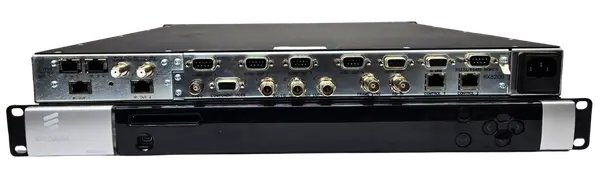
The Ericsson RX8200 remains, in 2026, one of the most complete, flexible, and reliable broadcast receivers on the secondary market. Its modular architecture, the robustness of the Ericsson firmware, and the availability of units with verified active licenses make it a hard option to beat for operators seeking broadcast quality without the price of new equipment.
If you are evaluating receivers for your headend, DTH operation, or IPTV platform, the RX8200 deserves to be on your shortlist.
👉 Check out the available unit with 21 active licenses and 1-year warranty →
Have questions about whether the RX8200 is the right fit for your infrastructure? Contact us directly — our technical team can help you evaluate the right configuration for your use case.